







ALT_IMG

Tutorials

Featuring short lessons and techniques, covering languages viz. PHP, MySQL, CSS, HTML, JavaScript, Java. The latest methods of developing web applications and basic tutorials of Java technology. You'll find free codes available in the post added with some video tutorials wherever applicable. Readmore...

ALT_IMG

How-To's

There went a rumour about the announcement of the Sony Xperia S and also we have seen some leaked photos of the model many time before. The latest leak photos had Sony Ericsson logo wearing on it but this final product image from CES has a Sony logo on the top Readmore..

Alt img

Tips and Tricks

Sony announces its very first mobile phone ‘Sony Xperia Ion’ in 10 years after it is being seperated from Ericsson at the CES 2012. Now the new products and devices is back with its brand logo of Sony instead of Sony Ericsson. is the first operator to have a Sony phone in the assortment Readmore...

ALT_IMG

Hacking Tricks

In the past few months we saw so many ultrabooks budding up in the electronic market. The Apple’s trendy MacBook Air gave the PC makers a cause to be anxious, since it is obvious that these thin-and-light laptops seems to be in a tough competiton with them. In general, Ultrabooks are the small, light, powerful Readmore...

ALT_IMG

Gadgets

The minute you get your hands on the Droid Xyboard, it is clear that this is a higher-caliber Android tablet while comparing with almost everything else available today. The tablet is sleek, properly balanced and felt comfortable in our hands. A completely new look, significantly enhanced performance and Readmore...

ALT_IMG

Internet Tweaks

There went a rumour about the announcement of the Sony Xperia S and also we have seen some leaked photos of the model many time before. The latest leak photos had Sony Ericsson logo wearing on it but this final product image from CES has a Sony logo on the top Readmore..

ALT_IMG

Tech News

There went a rumour about the announcement of the Sony Xperia S and also we have seen some leaked photos of the model many time before. The latest leak photos had Sony Ericsson logo wearing on it but this final product image from CES has a Sony logo on the top Readmore..

ALT_IMG

Downloads

There went a rumour about the announcement of the Sony Xperia S and also we have seen some leaked photos of the model many time before. The latest leak photos had Sony Ericsson logo wearing on it but this final product image from CES has a Sony logo on the top Readmore..

Showing posts with label PHP Captcha code. Show all posts
Thursday, 27 September 2012

How To Use Captcha in HTML Forms

0 comments


HTML forms are the essential needs of almost any website viz. contact us form. A contact us form is very useful as it aids your visitors to communicate easily in a simple way. A simple form, without a captcha on it are the chief look-outs of hackers and spammers. It is essential to secure your form against all 'holes' that those hackers are searching for.


How does the spammers/hackers exploit HTML forms?

1) As a relay for sending bulk unsolicited emails.

If you are not validating your form fields (on the serve side) before sending the emails, then hackers can alter your email headers to send the bulk unsolicited emails. (also known as email injection)


2) For sending spam messages to you.

There are programs known as 'spam-bots' that leech through the web pages looking for web forms. When found, those 'bots' just fills the fields with a spam message and submits. Eventually you will start getting many hundred submissions send by those spam bots and you will find it difficult to separate genuine submissions from spam messages.

The solution for this problem is to use a mechanism to identify human submitters from 'bots'. CAPTCHA is one of such tests.


Adding Captcha
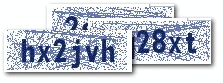

Captcha is an image with a code written on it. The website visitor is required to read the code on the image and enter the value in a text field. If the word entered is wrong, the form submission is not processed. As CAPTCHA is a smartly blurred image, the spam bot can't read it. So the form cannot be auto-submitted by a 'bot'.


Contact form with Captcha


<form method="POST" name="contact_form"
action="<?php echo htmlentities($_SERVER['PHP_SELF']); ?>">
<label for="name">Name: </label>
<input type="text" name="name"
value="<?php echo htmlentities($name) ?>">
<label for="email">Email: </label>
<input type="text" name="email"
value="<?php echo htmlentities($visitor_email) ?>">
<label for="message">Message:</label>
<textarea name="message" rows=8 cols=30>
<?php echo htmlentities($user_message) ?></textarea>
<img src="captcha_code_file.php?rand=<?php echo rand(); ?>"
id="captchaimg" >
<label for="message">Enter the code above here :</label>
<input id="6_letters_code" name="6_letters_code" type="text">
<input type="submit" value="Submit" name="submit">
</form>


The HTML form above contains the fields for name, email and message. In addition, we have the CAPTCHA image. The <img> tag for the CAPTCHA image points to the script captcha_code_file.php. The PHP script in 'captcha_code_file.php' creates the image for the captcha and saves the code in a session variable named '6_letters_code'.


Validating the CAPTCHA


When the form is submitted, we compare the value in the session variable(6_letters_code) with the submitted CAPTCHA code( the value in the text field 6_letters_code). If the codes match, then we proceed with emailing the form submission. Else we display an error.

Here is the code that does the server side processing:


if(isset($_POST['submit']))
{
  if(empty($_SESSION['6_letters_code'] ) ||
    strcasecmp($_SESSION['6_letters_code'], $_POST['6_letters_code']) != 0)
  {
   //Note: the captcha code is compared case insensitively.
   //if you want case sensitive match, update the check above to
   // strcmp()
    $errors .= "\n The captcha code does not match!";
  }
  if(empty($errors))
  {
    //send the email
    $to = $your_email;
    $subject "New form submission";
    $from = $your_email;
    $ip = isset($_SERVER['REMOTE_ADDR']) ? $_SERVER['REMOTE_ADDR'] : '';
    $body = "A user  $name submitted the contact form:\n".
    "Name: $name\n".
    "Email: $visitor_email \n".
    "Message: \n ".
    "$user_message\n".
    "IP: $ip\n";
    $headers = "From: $from \r\n";
    $headers .= "Reply-To: $visitor_email \r\n";
    mail($to, $subject, $body, $headers);
    header('Location: thank-you.html');
  }
}


Customizing the CAPTCHA

The CAPTCHA script in the sample code download can be customized. If you open the script, you can see the first few lines of the code as shown below:


$image_width = 120;
$image_height = 40;
$characters_on_image = 6;
$font = './monofont.ttf';
//The characters that can be used in the CAPTCHA code.
//avoid confusing characters (l 1 and i for example)
$possible_letters = '23456789bcdfghjkmnpqrstvwxyz';
$random_dots = 0;
$random_lines = 20;
$captcha_text_color = "0x142864";
$captcha_noise_color = "0x142864";


You can change the size of the CAPTCHA by changing $image_width & $image_height. The number of characters in the CAPTCHA can be changed by updating $characters_on_image. Similarly, the text color of the CAPTCHA can be customized by updating $captcha_text_color. The code adds some 'noise' in the image by adding random lines and dots. you can increase or decrease the noise. Please note that increasing the noise may make it difficult for your genuine visitors to read the code.


Screenshot -


Continue reading →
Friday, 29 June 2012

PHP Captcha Code

0 comments

In this tutorial I will explain how to create a Captcha in PHP. We are using some of the features available in PHP for creating an image. This is very simple and basic tutorial and we are not using any custom fonts for generating captcha image. And we know that captcha code used to avoid spam/abuse or auto-submission.


       Flickr Like Edit Title


Captcha.php
<?php
session_start();
$ranStr = md5(microtime());
$ranStr = substr($ranStr, 0, 6);
$_SESSION['cap_code'] = $ranStr;
$newImage = imagecreatefromjpeg("cap_bg.jpg");
$txtColor = imagecolorallocate($newImage, 00, 0);
imagestring($newImage, 555, $ranStr, $txtColor);
header("Content-type: image/jpeg");
imagejpeg($newImage);
?>

Verifying captcha code is equal or not
Here we are storing a captcha code in SESSION variable and while verifying we have to compare the session variable with user entered data.
$_SESSION['cap_code'] - is having actual captcha code
$_POST['captcha'] - user entered captcha code
<?php
if ($_SERVER['REQUEST_METHOD'] == 'POST')
{
if ($_POST['captcha'] == $_SESSION['cap_code'])
{
// Captcha verification is Correct. Do something here!
}
else 
{
// Captcha verification is wrong. Take other action
}
}
?>

Read This
The below html/CSS/Jquery code I used is just for an extra enhancement only and all the code is not needed actually. The above code is enough to check whether Human Verification is correct or wrong.

index.php
Contains HTML and PHP code. Image scr='captcha.php'
<?php
session_start();
$cap = 'notEq'; // This php variable is passed to jquery variable to show alert
if ($_SERVER['REQUEST_METHOD'] == 'POST')
{
if ($_POST['captcha'] == $_SESSION['cap_code'])
{
// Captcha verification is Correct. Do something here!
$cap = 'Eq';
}
else
{
// Captcha verification is wrong. Take other action
$cap = '';
}
}
?>
<html>
<body>
<form action="" method="post">
<label>Name:</label><br/>
<input type="text" name="name" id="name"/>
<label>Message:</label><br/>
<textarea name="msg" id="msg"></textarea>
<label>Enter the contents of image</label>
<input type="text" name="captcha" id="captcha" />
<img src='captcha.php' />
<input type="submit" value="Submit" id="submit"/>
</form>
<div class="cap_status"></div>
</body>
</html>

Javascript
<script type="text/javascript" src="http://ajax.googleapis.com/
ajax/libs/jquery/1.4.2/jquery.min.js
"></script>
<script type="text/javascript">
$(document).ready(function()
{
$('#submit').click(function()
{
var name = $('#name').val();
var msg = $('#msg').val();
var captcha = $('#captcha').val();
if( name.length == 0)
{
$('#name').addClass('error');
}
else
{
$('#name').removeClass('error');
}
if( msg.length == 0)
{
$('#msg').addClass('error');
}
else
{
$('#msg').removeClass('error');
}
if( captcha.length == 0)
{
$('#captcha').addClass('error');
}
else
{
$('#captcha').removeClass('error');
}
if(name.length != 0 && msg.length != 0 && captcha.length != 0)
{
return true;
}
return false;
});
var capch = '<?php echo $cap; ?>';
if(capch != 'notEq')
{
if(capch == 'Eq')
{
$('.cap_status').html("Your form is successfully Submitted").fadeIn('slow').delay(3000).fadeOut('slow');
}
else
{
$('.cap_status').html("Human verification Wrong!").addClass('cap_status_error').fadeIn('slow');
}
}
});
</script>


CSS
body{
width: 600px;
margin: 0 auto;
padding: 0;
}

#form{
margin-top: 100px;
width: 350px;
outline: 5px solid #d0ebfe;
border: 1px solid #bae0fb;
padding: 10px;
}

#form label
{
font:bold 11px arial;
color: #565656;
padding-left: 1px;
}

#form label.mandat
{
color: #f00;
}

#form input[type="text"]
{
height: 30px;
margin-bottom: 8px;
padding: 5px;
font: 12px arial;
color: #0060a3;
}

#form textarea
{
width: 340px;
height: 80px;
resize: none;
margin: 0 0 8px 1px;
padding: 5px;
font: 12px arial;
color: #0060a3;
}

#form img
{
margin-bottom: 8px;
}

#form input[type="submit"]
{
background-color: #0064aa;
border: none;
color: #fff;
padding: 5px 8px;
cursor: pointer;
font:bold 12px arial;
}

.error
{
border: 1px solid red;
}

.cap_status
{
width: 350px;
padding: 10px;
font: 14px arial;
color: #fff;
background-color: #10853f;
display: none;
}

.cap_status_error
{
background-color: #bd0808;
}


Continue reading →